
How Middle East Foam Manufacturers Can Improve AFFF Performance Under Extreme Heat
ON
Firefighting foam manufacturers in the Middle East face operating conditions that are very different from those in temperate regions. Warehouses, tank farms, refinery sites, port terminals, and fire stations may experience prolonged exposure to temperatures above 40°C. Containers stored outdoors can be exposed to even higher internal temperatures due to direct solar radiation.
These conditions can affect foam concentrate appearance, viscosity, surfactant compatibility, proportioning accuracy, and final foam performance. A product that performs well immediately after production may show separation, sediment, increased viscosity, or reduced foam expansion after months of hot storage.
For manufacturers developing AFFF for hot climate applications, thermal stability must be considered from the earliest formulation stage. The right balance of fluorosurfactants, hydrocarbon surfactants, solvents, stabilizers, preservatives, and packaging can help improve long-term reliability for refineries, oil terminals, aviation facilities, and industrial fire-protection systems.
Extreme Heat Challenges for Firefighting Foam Concentrate Storage
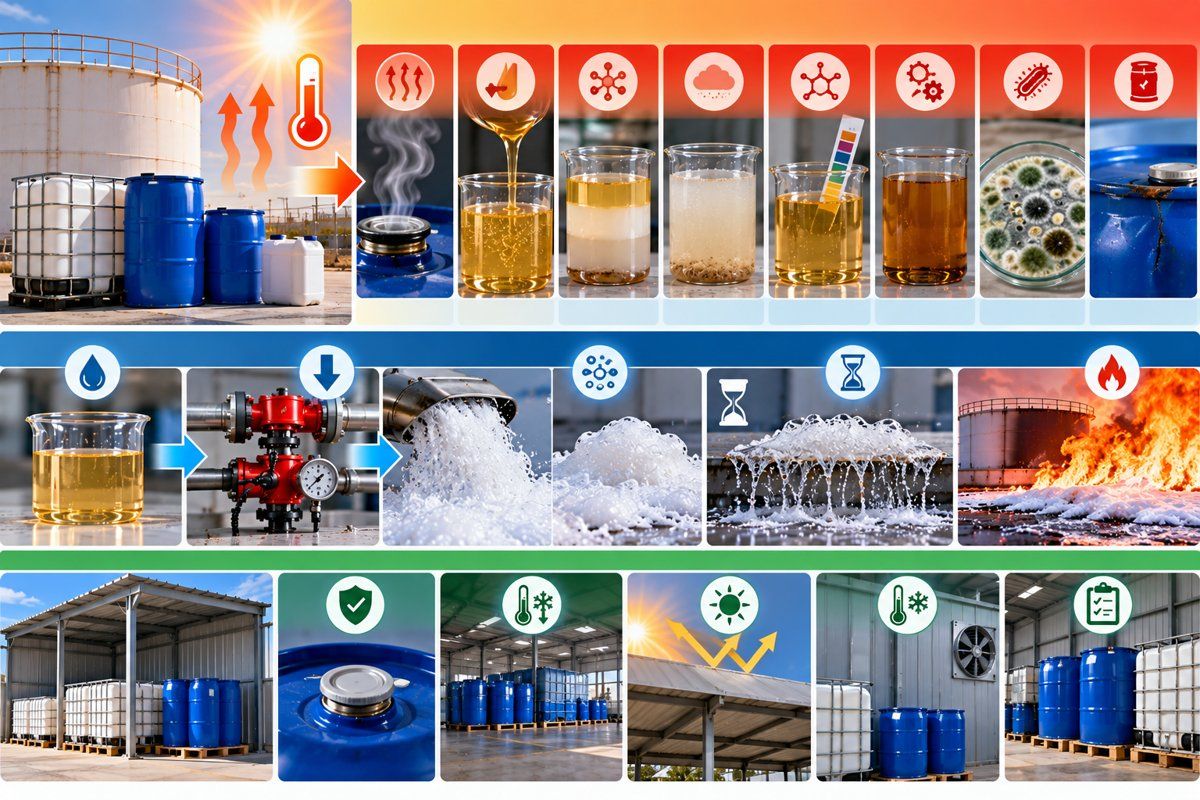
AFFF concentrate is a complex aqueous mixture. It may contain fluorinated surfactants, hydrocarbon surfactants, glycol-based solvents, hydrotropes, corrosion inhibitors, buffers, preservatives, and other performance additives. Each component must remain compatible during storage.
Under extreme heat, several problems can develop more quickly:
- Increased evaporation of volatile solvents from poorly sealed containers
- Viscosity increase or decrease due to solvent balance changes
- Phase separation between surfactant, solvent, and water-rich layers
- Haze, precipitation, or sediment formation
- Changes in pH and conductivity
- Faster oxidation or degradation of selected additives
- Increased risk of microbial activity in vulnerable formulations
- Container deformation, liner failure, or corrosion-related contamination
For this reason, a fluorosurfactant should never be assessed only by its initial surface-tension value. Manufacturers should evaluate it in the final AFFF formula after storage at relevant elevated temperatures.
Preventing Phase Separation and Viscosity Drift in AFFF
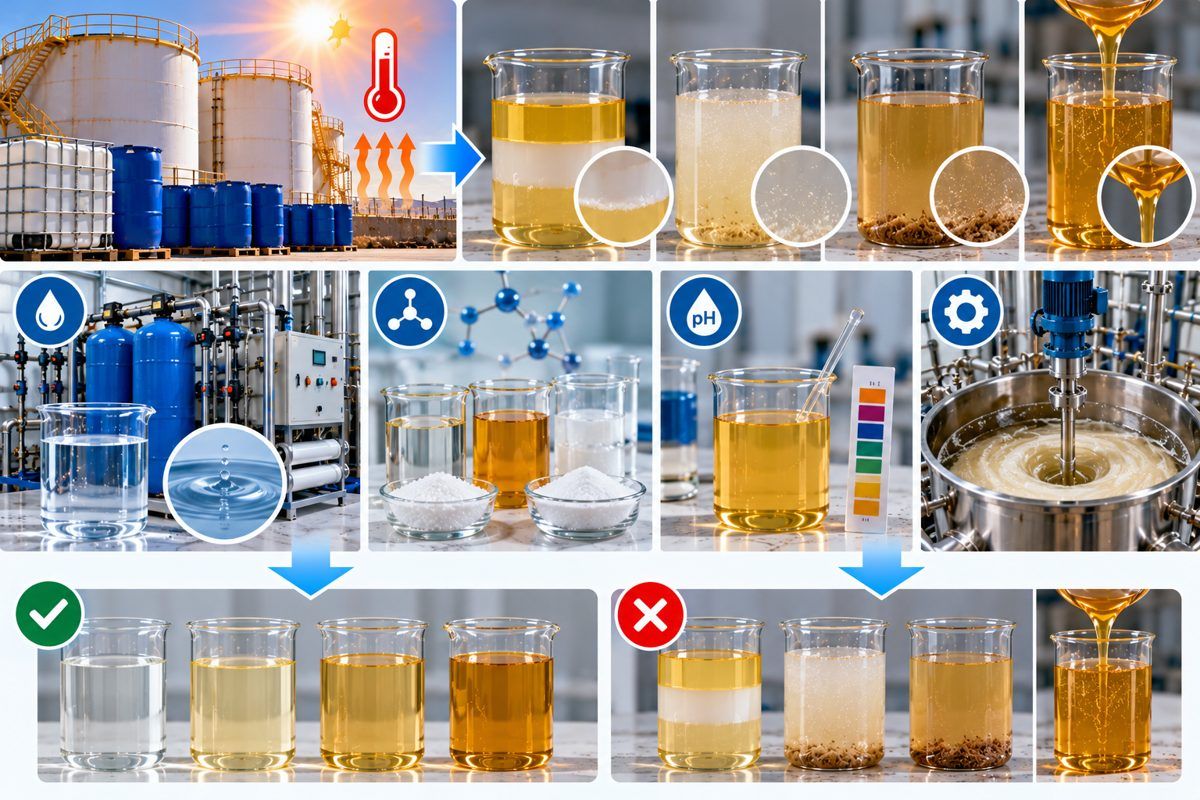
Phase separation and viscosity drift are common concerns in hot-climate foam concentrates. Prevention requires a full formulation approach rather than simply increasing fluorosurfactant dosage.
First, use process water with controlled quality. Calcium, magnesium, iron, chloride, and microbial contamination can destabilize surfactant systems. Demineralized or deionized water is generally preferred for manufacturing, with regular checks for conductivity, hardness, pH, and microbiological quality.
Second, optimize the solvent and hydrotrope package. The formulation must keep all surfactants dissolved across the intended temperature range without making the concentrate too thin, too volatile, or too difficult to proportion.
Third, control pH carefully. Surfactant compatibility can change significantly outside the preferred pH range. A robust buffer system can help minimize drift during storage, but all buffers and corrosion inhibitors should be tested for compatibility with the surfactant package.
Finally, control mixing conditions. Incorrect addition order, high local concentrations, excessive shear, or poor hydration can create instability that only becomes visible after aging. Manufacturers should establish documented batch procedures covering mixing speed, addition sequence, temperature, and hold time.
Selecting Fluorosurfactants for Refinery and Oil Terminal Applications
Refineries, crude-oil terminals, fuel depots, and petrochemical sites require foam concentrates designed for specific fire risks, application equipment, and water sources. In many Middle East projects, foam may be used with freshwater, hard water, brackish water, or seawater.
When selecting a fluorosurfactant for AFFF, manufacturers should evaluate:
- Compatibility with the full surfactant and solvent system
- Stability at high storage temperatures
- Performance in freshwater and expected alternative water sources
- Surface tension before and after heat aging
- Foam expansion ratio and 25% drainage time
- Fuel shedding and spreading behavior on applicable hydrocarbons
- Compatibility with foam proportioners and discharge equipment
- Batch-to-batch consistency from the raw-material supplier
- Regulatory and customer-specific requirements for the intended market
No individual raw material can guarantee approval of the final foam concentrate. Product certification or acceptance applies to the complete, tested formulation under the relevant standard or customer specification.
Recommended Accelerated Heat-Aging Evaluation Methods
Accelerated aging is a practical way to identify formulation weaknesses before full-scale production. It does not replace real-time shelf-life testing, but it can reveal incompatibility, separation, and viscosity changes much sooner.
A useful internal test program may include storing sealed samples at elevated temperatures such as 50°C, 55°C, or 60°C for defined periods. The exact conditions should reflect applicable standards, customer requirements, and intended storage conditions.
Before and after aging, test:
- Appearance, color, haze, and sediment
- pH, density, viscosity, and conductivity
- Surface tension at the intended use concentration
- Foam expansion and drainage time
- Dilution clarity in freshwater, hard water, and seawater
- Performance after freeze-thaw conditioning where required
- Container integrity and compatibility
For AR-AFFF, additional attention should be given to polymer stability, gel formation, viscosity increase, and preservative effectiveness.
Packaging and Storage Recommendations for Foam Raw Materials
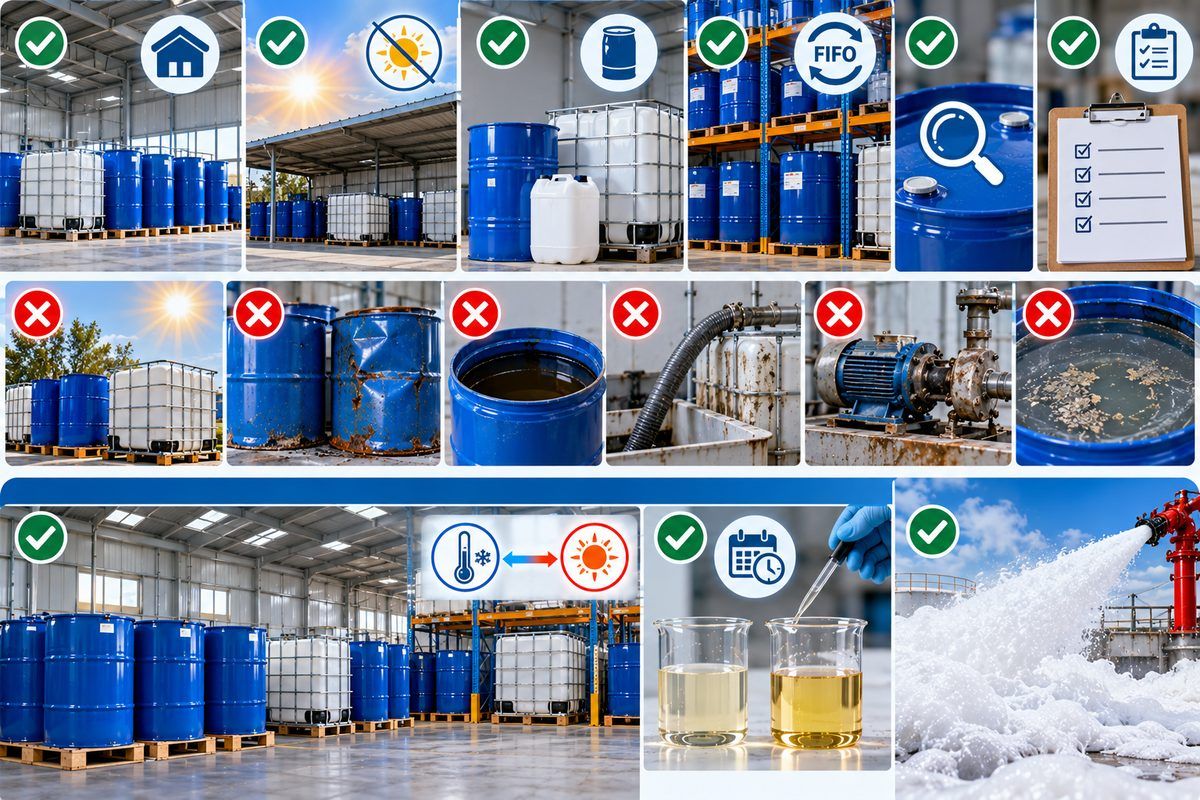
Even a stable formulation can fail if raw materials are stored incorrectly. Fluorosurfactants and other foam ingredients should be kept in sealed, properly labeled containers away from direct sunlight and excessive heat.
Recommended practices include:
- Store raw materials indoors or under covered, ventilated conditions
- Avoid prolonged exposure to direct sun
- Use compatible drums, IBCs, seals, and liners
- Rotate stock using first-in, first-out inventory control
- Inspect containers for leakage, swelling, corrosion, or sediment
- Keep records of batch number, receipt date, storage temperature, and shelf life
- Avoid contamination from open transfer lines, dirty tanks, or unsuitable pumps
Finished AFFF concentrates should also be stored within the supplier’s recommended temperature range and inspected periodically during long-term storage.
Technical Support for Middle East AFFF Manufacturers
Developing reliable firefighting foam for the Middle East requires more than selecting individual ingredients. The finished formulation must be tested under realistic storage, water-quality, and application conditions.
ONESCHEM supports AFFF and AR-AFFF manufacturers with fluorosurfactant solutions, technical documentation, and formulation compatibility discussions. Manufacturers can request TDS, SDS, COA, samples, and technical support for evaluating heat aging, surfactant compatibility, storage stability, and foam performance.
For hot-climate applications, early screening and disciplined quality control can help reduce phase separation, viscosity drift, foam expansion failures, and customer complaints—while supporting more reliable foam performance at refineries, terminals, and industrial fire-protection sites.