
Why Some AFFF Formulations Fail Foam Expansion Tests After Long-Term Storage
ON
A newly produced AFFF concentrate may pass every laboratory test, but after one or two years in a warehouse or fire station it can show lower expansion, faster drainage, or weaker spreading. For foam manufacturers, this type of AFFF foam expansion failure can lead to customer complaints, rejected inspection samples, and costly product replacement.
Most storage-related failures are not caused by a single raw material. They result from gradual chemical, physical, or microbiological changes that were not identified during formulation development. Understanding these mechanisms is the first step toward improving firefighting foam storage stability.
Typical Causes of Reduced Foam Expansion After Storage
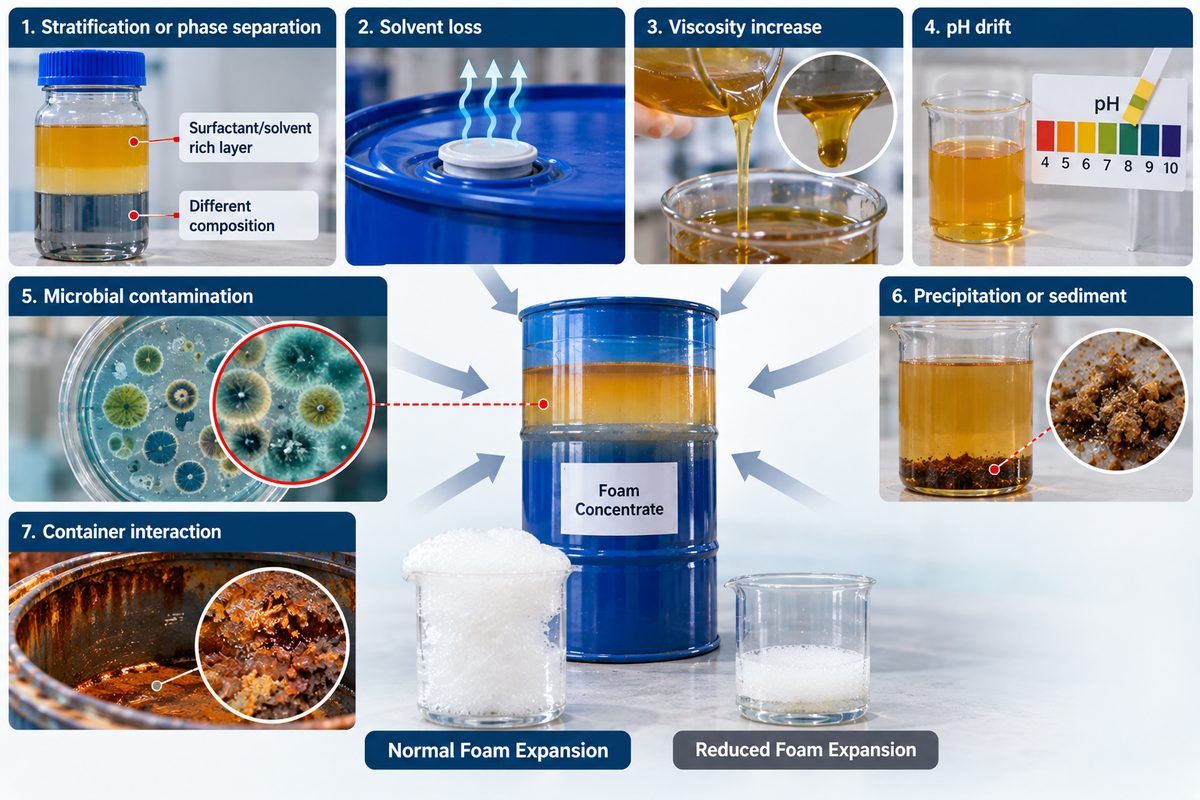
Foam expansion depends on the concentrate's ability to generate and stabilize bubbles at the correct proportioning rate. Over time, several changes can weaken this ability:
- Stratification or phase separation: Surfactants or solvents concentrate in one layer, so samples drawn from the top or bottom of a container are no longer representative.
- Solvent loss: Poorly sealed containers allow volatile components to evaporate, changing solubility and viscosity.
- Viscosity increase: Thicker concentrate may be under-proportioned through inductors or proportioners, producing a weaker foam solution.
- pH drift: Changes in pH can affect surfactant solubility and accelerate degradation of sensitive components.
- Microbial contamination: Bacteria can degrade hydrocarbon surfactants and, in AR-AFFF, polysaccharide polymers.
- Precipitation or sediment: Insoluble material forms from incompatible components, hard-water ions, or corrosion products.
- Container interaction: Corroded metal drums or unsuitable liners may introduce iron and other contaminants.
The Impact of Surfactant Incompatibility and Raw Material Quality Variation
AFFF concentrates are multi-component systems containing fluorosurfactants, hydrocarbon surfactants, glycol ethers or other solvents, stabilizers, preservatives, and corrosion inhibitors. Some combinations remain clear at production but slowly interact during storage, forming complexes, haze, or sediment.
Anionic and cationic or amphoteric components, for example, can form less soluble associations under certain pH or electrolyte conditions. These changes may develop over months rather than days.
Raw material variation adds another risk. Differences in active content, impurity profile, chain-length distribution, residual salts, or pH between batches can shift the formulation balance. A supplier change made without re-evaluation is a frequent hidden cause of storage failures.
Process water quality also matters. Calcium, magnesium, iron, or microbial contamination introduced during manufacturing can reduce long-term stability. Deionized water with controlled conductivity and microbial quality is recommended for production.
Fluorosurfactant Stability Under High-Temperature Storage
A suitable fluorosurfactant for foam concentrate must remain compatible with the complete formulation throughout the intended storage period, not only at the time of blending. The fluorinated chain itself is generally chemically robust, but its interaction with co-surfactants, solvents, and electrolytes can change at elevated temperatures.
High storage temperatures, common in Southeast Asia and the Middle East, may increase molecular mobility and accelerate interactions that would occur slowly at room temperature. Results may include haze, layer formation, or changes in surface tension of the diluted solution.
Manufacturers should compare candidate fluorosurfactants in the finished concentrate before and after heat aging, measuring surface tension, spreading behavior, expansion, and drainage time.
How to Evaluate Foam Concentrate Shelf-Life During Formulation Development
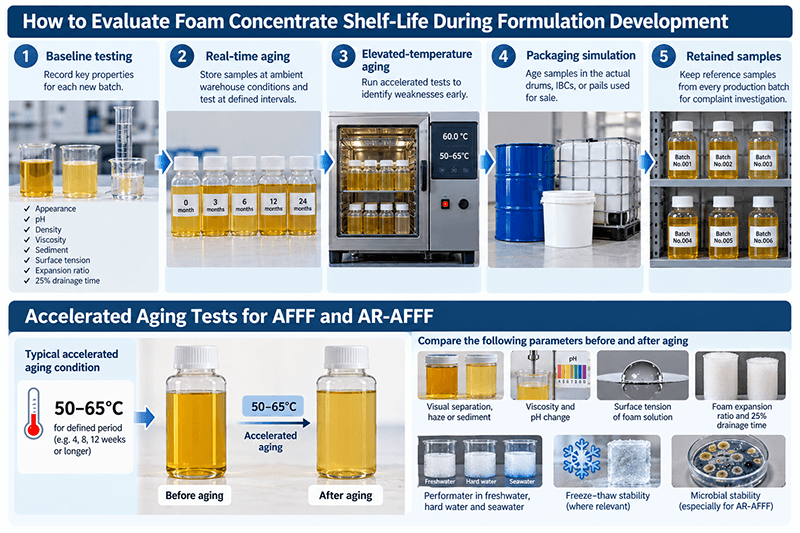
Shelf-life evaluation should begin at the formulation stage, not after commercial launch. A practical program includes:
- Baseline testing: Record appearance, pH, density, viscosity, sediment, surface tension, expansion ratio, and 25% drainage time for each new batch.
- Real-time aging: Store retained samples at ambient warehouse conditions and test them at defined intervals, such as 3, 6, 12, and 24 months.
- Elevated-temperature aging: Run accelerated tests in parallel to identify weaknesses early.
- Packaging simulation: Age samples in the actual drums, IBCs, or pails used for sale.
- Retained samples: Keep reference samples from every production batch for complaint investigation.
Accelerated Aging Tests for AFFF and AR-AFFF
Accelerated aging helps screen formulations, but it does not perfectly predict real shelf life. Some foam specifications include short-term elevated-temperature conditioning before performance testing; internal programs often extend this with longer storage at 50–65°C.
A typical evaluation compares samples before and after aging for:
- Visual separation, haze, or sediment
- Viscosity and pH change
- Surface tension of the foam solution
- Foam expansion ratio and 25% drainage time
- Performance in freshwater, hard water, and seawater
- Freeze-thaw stability where relevant
For AR-AFFF, pay special attention to viscosity changes, gel formation, and microbial stability, as polymer systems are more sensitive. Preservative effectiveness should be verified over the intended shelf life. Final certification testing must always follow the applicable standard, such as EN 1568, UL 162, or customer specifications.
Troubleshooting Guide for Foam Manufacturers
| Observation | Possible Cause | Suggested Action |
| Low expansion, normal appearance | Under-proportioning due to viscosity rise | Check viscosity; verify proportioning rate |
| Layer separation | Surfactant or solvent incompatibility | Review solvent balance and component ratios |
| Sediment or haze | Hard-water ions, precipitation, corrosion | Check process water and container condition |
| Odor, slime, or pH drop | Microbial growth | Review preservative system and plant hygiene |
| Batch-to-batch variation | Raw material quality changes | Compare COAs; test retained samples |
| Faster drainage time | Degraded foam stabilizers | Re-evaluate stabilizer and surfactant package |
Always mix the container thoroughly and sample correctly before concluding that a formulation has failed.
Selecting Consistent Fluorosurfactant Suppliers
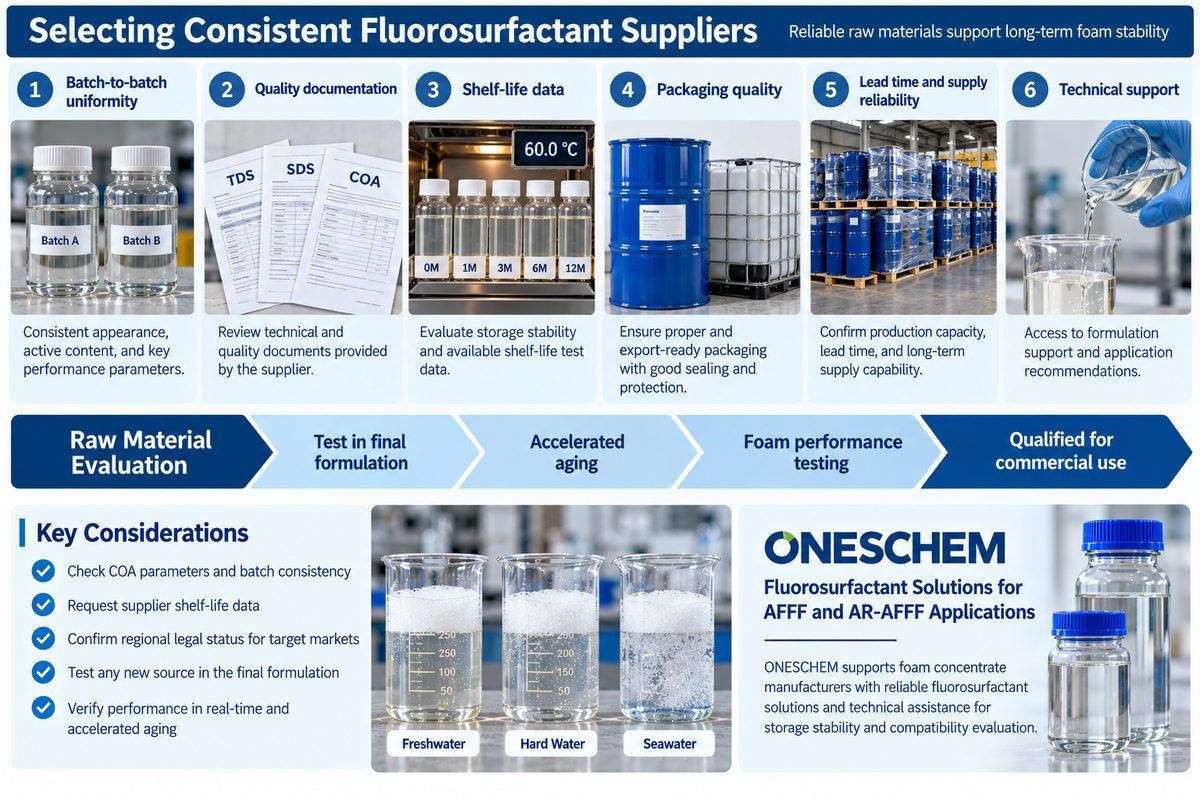
Long-term foam stability depends heavily on raw material consistency. When qualifying a supplier, foam manufacturers should evaluate batch-to-batch uniformity, COA parameters, shelf-life data, packaging quality, lead time, and technical support.
Request the TDS, SDS, COA, and product-specific regulatory documentation. Because fluorinated substances are subject to evolving regional restrictions, confirm the legal status of each material in the markets where the finished foam will be sold. Any new source should be tested in the final formulation, including accelerated aging, before commercial use.
ONESCHEM supports foam concentrate manufacturers with fluorosurfactant solutions for AFFF and AR-AFFF applications. Contact our technical team to request samples, TDS, SDS, COA, or support with storage stability and compatibility evaluation.